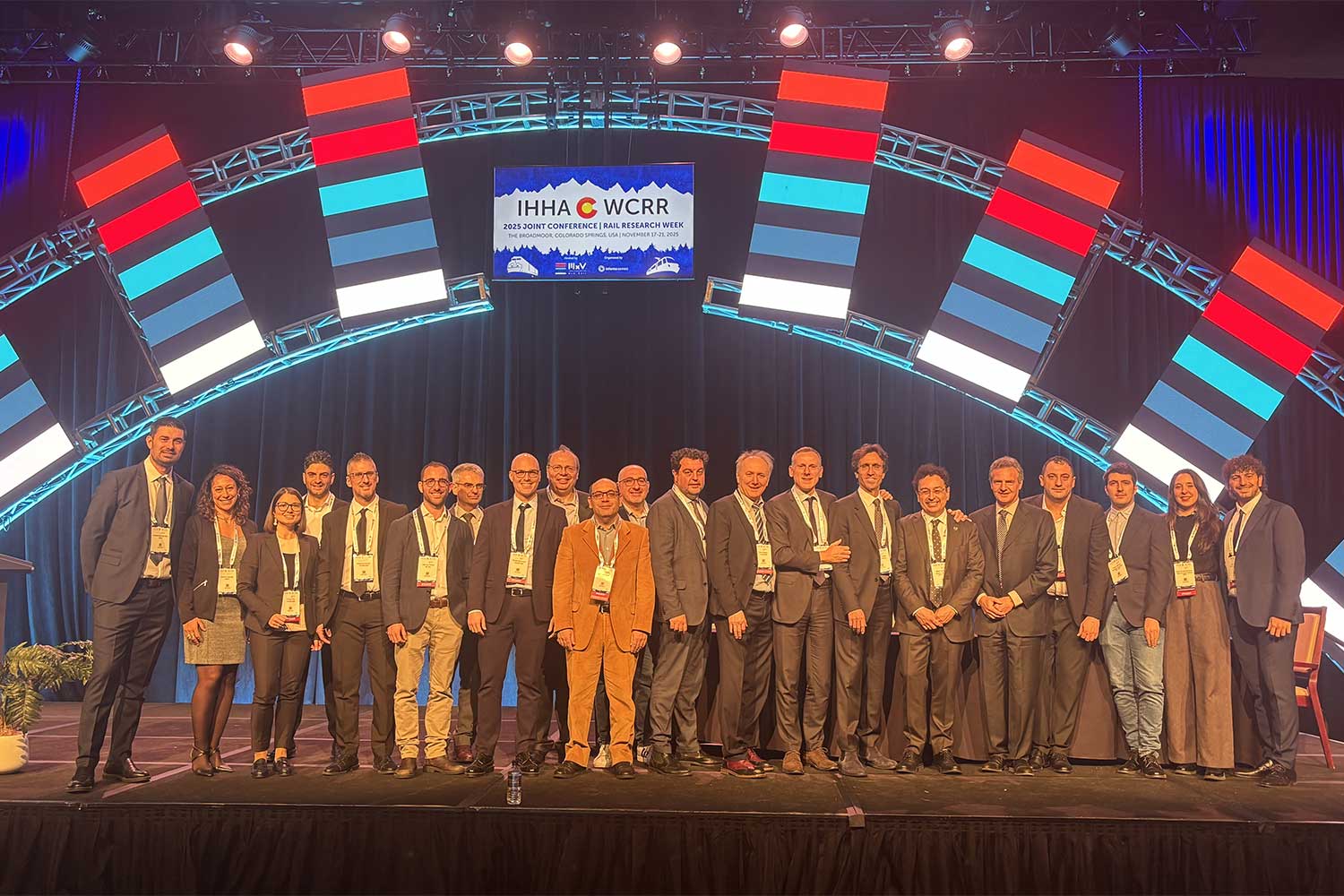
HIGHLIGHTS OF THE PRESENTED PAPERS
|
Enhancing Process Efficiency and Project Sustainability with Information Management (Alessandro Mambrin) |
|---|
The paper describes how Italferr has adopted an integrated digital approach to improve efficiency, quality and sustainability in infrastructure design. At the heart of this approach is project data management, by collecting, structuring and sharing the data to ensure traceability, multidisciplinary collaboration and compliance with standards. The data flow starts with high-precision surveys (point clouds) from which BIM models are created and immediately integrated with the GIS data relating to the constraints and characteristics of the local areas. All these elements then flow into the Digital Twin platform, which allows the project to be visualised, analysed and simulated in real time, to support the technical, environmental and economic decisions. Even in the early stages, the method allows for quick comparison of design alternatives via interactive dashboards, linking models, quantities and costs for transparent, data-driven evaluation. One of the objectives of this approach is also to facilitate communication with the local authorities and communities, to make the project more comprehensible to the public and encourage public discussion. In conclusion, the integration of ACDat, BIM, GIS and Digital Twin enables Italferr to achieve faster, more coordinated and sustainable processes, resulting in shorter design times, savings in subsequent phases and improved quality information management. |
Technology systems in rail way infrastructure (Caterina Varriale) |
|---|
This research introduces an innovative approach because, for the first time, railway technologies like signalling, telecommunications, electric traction, lighting and power systems can be integrated into a BIM model. The aim is to create interoperable federated models that allow the early identification of conflicts and variations, thus improving the accuracy and efficiency of project lifecycle management. Railway technology specialists are involved from the early stages, through multi-level checks and clash detection on federated models. This makes it possible to bring forward the production of specialised models and digitally resolve interferences that, in traditional workflows, would only emerge on the construction site, causing delays, extra costs and modifications during construction. The proposed integration addresses the complexity of modelling linear systems like signalling, catenary, power supply and TLC networks, ensuring design consistency and minimising the risk of error. |